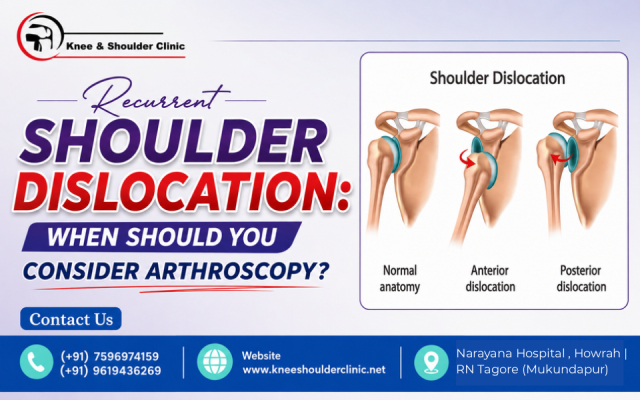
A shoulder dislocation happens when the joint loses its normal alignment. After the first episode, some people recover well with immobilisation and rehabilitation, while others develop repeated instability. People searching for orthopaedic shoulder doctors in howrah often do so because the shoulder keeps slipping out, feels unreliable, or dislocates again during routine activity. Recurrent dislocation […]
A shoulder dislocation happens when the joint loses its normal alignment. After the first episode, some people recover well with immobilisation and rehabilitation, while others develop repeated instability. People searching for orthopaedic shoulder doctors in howrah often do so because the shoulder keeps slipping out, feels unreliable, or dislocates again during routine activity. Recurrent dislocation is known as chronic shoulder instability and may be associated with injury to the labrum or surrounding stabilising tissues.
Not every repeated dislocation requires surgery. Treatment usually begins with a careful assessment of how often the shoulder dislocates, what activities trigger it, the person’s age and activity level, and whether structured physiotherapy has restored stability. Imaging may also be used to identify damage to the labrum or other structures that help keep the shoulder joint secure.
Arthroscopy may be considered when instability continues despite appropriate rehabilitation, when dislocations occur repeatedly, or when a structural injury is contributing to the problem. During shoulder arthroscopy, a small camera and specialised instruments are inserted through small incisions. The surgeon can assess the joint and, when appropriate, repair a torn labrum or tighten stretched tissues to improve stability.
One common injury linked with recurrent anterior shoulder dislocation is a Bankart lesion, in which part of the labrum is torn from the socket. Arthroscopic repair is one recognised treatment for recurrent shoulder instability, but the best approach depends on the pattern and severity of damage. In some cases, significant bone loss or complex instability may require a different surgical strategy rather than a standard arthroscopic repair.
At Knee and Shoulder Clinic, the key consideration should be whether the shoulder remains unstable enough to affect daily movement, work, sleep, exercise, or confidence in using the joint. A specialist assessment helps determine whether continued rehabilitation is reasonable or whether surgery should be discussed.
Someone searching for a shoulder surgeon near me should remember that the decision for arthroscopy is not based only on the number of dislocations. Symptoms, examination findings, imaging, tissue damage, activity demands, and the risk of future instability all matter. Early evaluation after repeated episodes can help clarify the cause and guide an appropriate treatment plan.